Tuesday, August 30, 2011
New Lecture by FPAN Northeast!
FPAN Northeast has added a new lecture to the books:
Laurel Grove Plantation was destroyed in 1813 as a result of the Patriots' Rebellion (or Patriot War). In documenting his losses there, Zephaniah Kingsley supplied unusually detailed information about the enslaved Africans living at the plantation. Those records informed archaeological interpretation of another of his properties, Kingsley Plantation on Fort George Island. Excavations at Kingsley Plantation by the University of Florida's archaeology field school (2006-2011) offer a wealth of understanding about what life was like for the plantation's inhabitants.
Though it's still brand new, I had the pleasure of delivering the inaugural lecture before members of the Historical Society of Orange Park--right where Laurel Grove Plantation once stood!
For information on bringing a lecture to your group, contact Amber. To find out about our other lectures and offerings, visit our Programs page.
Photo courtesy of University of Florida, Dr. James Davidson
Thursday, August 25, 2011
Protecting the past, one bumper at a time!
From time to time we make reference to our "I DIG 1565" bumper sticker, and it just occurred to me that some of you might not know what we're talking about.
Several years ago in an effort to support New Smyrna Beach's city archaeological ordinance, Ponce Inlet's archaeology ordinance, and Volusia County's preservation ordinance we developed a "Volusia's in Ruins" bumper sticker. The idea was to hand out the bumper sticker at displays where we could explain the importance of the ordinance and pass out a copy for the public to view. Establishing an archaeological ordinance is the best chance a community has at preserving its buried past, its heritage. And while starting one can be difficult, keeping it on the books can be even harder in these economic times.
With the Volusia experience under our belt we turned our attention to other city or county communities with established ordinances. While some St. Augustine residents are aware we have our very own city archaeologists, Carl Halbirt, they may not be aware of the archaeological ordinance that created his position. St. Augustine was the obvious choice for the next design, and our most popular. We chose 1565 to overlap with the 450th commemoration and establishing date for our town. Below the motto is the simple statement: Support Saint Augustine Archaeology. We passed these out at the city birthday commemorations, SAAA lectures, the Discover First America series, and they are available anytime at our Center that is open to the public on Flagler College campus.
We have another bumper sticker ready to roll out: Piecing Together Our Past, Support St. Johns County Archaeology. In a tie for oldest county in Florida, St. Johns county has an archaeological ordinance and a historical resource specialist, Robin Moore, to monitor historic properties owned by the county.
It always gives me great joy when driving up Highway 1 to see the bumper stickers and know the passion for the past is as magical as osmosis. Bumper stickers are available at FPAN northeast events and at our Center. If you are out of town or not able to attend our events, try for one of our "What Is It Wednesday" contests featured on this blog, our facebook and twitter. Or if you promise to put it on your car and send me a picture, first 10 to contact me and mention this blog post get a sticker of their choice!
Text: Sarah Miller, FPAN staff
Images: graphics developed by Flagler College graphic design interns: Kate Groeneveld-Volusia,
Several years ago in an effort to support New Smyrna Beach's city archaeological ordinance, Ponce Inlet's archaeology ordinance, and Volusia County's preservation ordinance we developed a "Volusia's in Ruins" bumper sticker. The idea was to hand out the bumper sticker at displays where we could explain the importance of the ordinance and pass out a copy for the public to view. Establishing an archaeological ordinance is the best chance a community has at preserving its buried past, its heritage. And while starting one can be difficult, keeping it on the books can be even harder in these economic times.
With the Volusia experience under our belt we turned our attention to other city or county communities with established ordinances. While some St. Augustine residents are aware we have our very own city archaeologists, Carl Halbirt, they may not be aware of the archaeological ordinance that created his position. St. Augustine was the obvious choice for the next design, and our most popular. We chose 1565 to overlap with the 450th commemoration and establishing date for our town. Below the motto is the simple statement: Support Saint Augustine Archaeology. We passed these out at the city birthday commemorations, SAAA lectures, the Discover First America series, and they are available anytime at our Center that is open to the public on Flagler College campus.
We have another bumper sticker ready to roll out: Piecing Together Our Past, Support St. Johns County Archaeology. In a tie for oldest county in Florida, St. Johns county has an archaeological ordinance and a historical resource specialist, Robin Moore, to monitor historic properties owned by the county.
It always gives me great joy when driving up Highway 1 to see the bumper stickers and know the passion for the past is as magical as osmosis. Bumper stickers are available at FPAN northeast events and at our Center. If you are out of town or not able to attend our events, try for one of our "What Is It Wednesday" contests featured on this blog, our facebook and twitter. Or if you promise to put it on your car and send me a picture, first 10 to contact me and mention this blog post get a sticker of their choice!
Text: Sarah Miller, FPAN staff
Images: graphics developed by Flagler College graphic design interns: Kate Groeneveld-Volusia,
Katelyn Calautti-St. Augustine and St. Johns County.
Wednesday, August 24, 2011
"What Is It???" Wednesday: MOSH Scene 2, Take 1
Last weekend we pulled off the second Archaeology Roadshow at Jacksonville's Museum of Science and History. In keeping with professional and museum ethics, the event featured panelists from multiple sciences and no monetary amounts were given to any attendees by the panelists. Visitors to the museum could take an unidentified object and get an archaeologist (people), paleontologist (fossils), or malacologist (shells) to examine the piece and provide some information. From the archaeological point of view, the event affords us the chance to find out local sites. Toni, our Site ID team leader, is always willing to follow up and record reported sites to the Florida Master Site File.
I could not have pulled off the day (134 objects in 120 minutes!) for the archaeology table without the help of Dr. Brad Biglow and Jennifer Knutson, so thanks again for volunteering your time!
There were more than a few objects that "stumped the chumps" and in following up with pictures and promises to find out more, I've stumbled upon some that are new to me or provided information that will serve me on a future dig.
First up, a vase I nearly knocked over while taking this photo (see below). I've done a little digging and think I have an answer for the person who brought the object forward. But for fun let's send it on a WIIW tour!
Last week's answer: a doublet button! Button was recovered from Carl's dig at the Spanish Quarter and may date to the 16th century. From today's St. Augustine Record article:
Text and Photos: Sarah Miller, FPAN staff
I could not have pulled off the day (134 objects in 120 minutes!) for the archaeology table without the help of Dr. Brad Biglow and Jennifer Knutson, so thanks again for volunteering your time!
There were more than a few objects that "stumped the chumps" and in following up with pictures and promises to find out more, I've stumbled upon some that are new to me or provided information that will serve me on a future dig.
First up, a vase I nearly knocked over while taking this photo (see below). I've done a little digging and think I have an answer for the person who brought the object forward. But for fun let's send it on a WIIW tour!
WHAT IS IT?!?!?
Let me know technique and any other diagnostic information that could help us narrow down an answer to who made it and when. Diagnostic information = I Dig 1565 bumpersticker!
Last week's answer: a doublet button! Button was recovered from Carl's dig at the Spanish Quarter and may date to the 16th century. From today's St. Augustine Record article:
"The men's doublet button is clearly from the period of 1590 to 1620," he said. "While people might carry around an old coin for years past its mint date, fashion doesn't tend to lie. In those days, clothes just didn't last very long, so what you wore was never very old."
Closest guess was made on Facebook by Debby Westerman, contact me and we'll mail you out your bumpersticker!
Text and Photos: Sarah Miller, FPAN staff
Tuesday, August 23, 2011
Help Needed: Inquire Within
We are seeking a curriculum consultant to develop science modules for middle school grades based on prehistoric Timucuan technology. See official Request for Proposals attached to this email and pasted below, or the program description. For questions or information, please contact Sarah Miller. Proposals due 2:00 PM EDT by Thursday, September 15, 2011.
Timucuan Technology: Biotechnology and Archaeology Lesson Plans
Official Request for Proposal:
Flagler College is seeking proposals from qualified firms or individuals to prepare the lesson plans for a new program focusing on biotechnology of Timucuan Indians through the study of archaeology in northeast Florida. Students will explore human interaction with the environment and changes made over time by the Timucua to meet their basic needs through biological products. The lessons will be completed by April 2012 to be published as a teacher resource guide and student handbook, provided on-line and through workshops by the Florida Public Archaeology Network’s Northeast Regional Center during June 2012.
The criteria for selection of interviews and the final selection include:
A. A minimum of three years experience as a curriculum consultant, with at least one year experience writing for Sunshine State Standard content;
B. A minimum of five years experience in science, social studies, or environmental education;
C. A minimum of one year experience in teacher training;
D. A minimum of one year experience with grant funded projects preferred; and
E. Demonstrated ability of the firm or individual to complete projects meeting the owner’s schedule and budget.
Lesson plans will:
• Be developed for 7th and 8th grades;
• Meet Sunshine State standards and be integrated into the Viva Florida Program;
• Incorporate ideas for science experiments to enhance learning; and
• Include information on (but not limited to): archaeology, ecology, geology, genetics, chemistry, technology, biotechnology, climate change, agronomy, and scientific ethics.
Proposals should provide a clear and concise outline for satisfying the objectives of this RFP. The proposals should outline the respondent’s qualifications to conduct the analyses. Proposals may include background, unique qualifications and other information that may support the proposal. Respondents are required to submit the following information: Qualifications; Outline of Proposed Content; two-page Description of Activities; Project Schedule; and sample lesson plan from prior work.
Proposals will be received at 74 King Street until 2:00 PM EDT by Thursday, September 15, 2011. Please submit your proposal to Ms. Sarah Miller, 74 King Street, St. Augustine, Florida 32084. Electronic submittals will be accepted, however you must call to confirm receipt of your electronic submission. If you should have any questions on this request, please contact Ms. Miller.
Flagler College reserves the right to waive informalities, to reject any or all bids/proposals and accept all or any part of any bid/proposal as deemed to be in the best interest of Flagler College.
THIS PROJECT HAS BEEN FINANCED IN PART WITH HISTORIC PRESRVATION ASSISTANCE PROVIDED BY THE BUREAU OF HISTORIC PRESERVATION, DIVISION OF HISTORICAL RESOURCES, FLORIDA DEPARTMENT OF STATE.
RFP (PDF) and Program Description (PDF) will be available soon on the program page of our website.
Wednesday, August 17, 2011
"What Is It???" Wednesday
Post your best guess by comment, Facebook or Twitter. Winner gets an "I Dig 1565" bumper sticker!
Last week's answer: it's a date! A date nail, anyway. "Date nails were driven into railroad ties, bridge timbers, utility poles, mine props, and other wooden structures for record keeping purposes (Oaks 2001)." The one photographed came from the Monticello Railway Museum in Illinois but is similar to those found throughout the US. For more information check out University of Indianapolis Math professor Jeff Oak's web page Date Nail Info (2001), author of Date Nails and Railroad Tie Preservation (1999).
Last week I got to go out for a morning and help Carl on his latest dig downtown. I took photos of my feature (a large post) and artifacts from other areas of the site. The last two images feature this week's WIIW.
![]() |
| Carl gives me my assignment |
![]() |
| Me sweet talking my post hole. |
![]() |
| Artifacts from the post. |
![]() |
| Mapping the site. |
![]() |
| St. Johns sherd. |
![]() |
| Taking the time to talk to the public. |
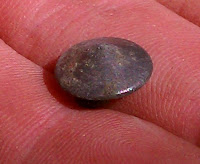
Alright, you're all warmed up now...take a look at the artifact below in Donald's palm. Yes it's a button, but what kind of button?
WHAT IS IT???
Last week's answer: it's a date! A date nail, anyway. "Date nails were driven into railroad ties, bridge timbers, utility poles, mine props, and other wooden structures for record keeping purposes (Oaks 2001)." The one photographed came from the Monticello Railway Museum in Illinois but is similar to those found throughout the US. For more information check out University of Indianapolis Math professor Jeff Oak's web page Date Nail Info (2001), author of Date Nails and Railroad Tie Preservation (1999).
Text and images: Sarah Miller, FPAN staff
Monday, August 15, 2011
Monday Morning Book Review: Shipwreck (Fast Forward)
You may find this book hard to come by, but if you are in heritage education the quest to get Shipwreck by Claire Aston with illustrations by Peter Dennis will well be worth your trouble. The book follows a Spanish shipwreck from construction to its demise, rediscovery, and ultimate ending of a maritime heritage museum. Let’s
crack it open for a closer look.
First, I LOVE that the book begins where maritime research begins: boat construction. Before you have a shipwreck, you have to have a ship. And to understand what kind of ship you have, you must understand ship construction and diagnostic markers of the craft. In classrooms I point out the parts of the ship archaeologists will be more likely to come across: planks, frames, keel if they’re lucky.
The ship is loaded, sets out and is attacked by pirates. Okay, okay, I know what you’re thinking…you had me until pirates. I use the images as an opportunity to show how the material culture is the same between the two sides of the battle. How could an archaeologist ever know if they have evidence of a pirate? What are the ways shipwrecks can be identified down to the vessel name?
This shipwreck story has an unbelievably happy ending. It is rediscovered by sport divers and eventually an archaeological unit is brought in to properly excavate the site. Information from the wreck is used to create a replica and outdoor museum where the public can go and learn about the history of the ship and those who worked on board. There’s only a handful of wrecks that have experienced such a success. The Vasa and King Henry XIII's Mary Rose come to mind. But this is the goal--to discover and share significant sites with the public.
The book is comparable to Discovery Kids' series that includes A Street Through Time, A City Through Time, and A Port Through Time. They’re all good for showing change in landscapes over time but lack the archaeological component in Shipwreck. In the credits Dr. Lucy Blue at the Centre for Maritime Archaeology is cited as the consultant. The information presumably gain from Dr. Blue comes through in both the text and illustration.
![]() |
| Beautiful illustrations by Peter Dennis. |
Shipwreck [Fast Forward (Barron's)] 2001 by Claire Aston and Peter Dennis.
There are 6 (SIX) available on Amazon or you can look around for a used copy.
Wednesday, August 10, 2011
"What Is It???" Wednesday
![]() |
| Mystery object, you tell us! |
This artifact could be found all over the country. Any guesses?
WHAT IS IT???
Last week seemed to stump the chumps...it's a fragment from a 24 lb cannon ball associated with Carl's on-going dig at the Spanish Quarter (view last week's post for pics). Given the time period of the strata the fragment came from, could be from Oglethorpe's 1740 siege of St. Augustine!
Monday, August 8, 2011
Monday Morning Book Review: Archaeologists Dig for Clues
Morning! Inspired by a PowerPoint our intern Sarah Bennett put together, I though "Hey, why not share our list of favorite archaeology books with others!" Thus Monday Morning Book Review is born.
First up, Archaeologist Dig for Clues by Kate Duke. This soft cover, colorful publication by HarperCollins (1997) is a great starter for kids ages 5 and up. The colorful illustrations by Kate allow young readers to follow a class fieldtrip to an archaeological dig.
![]() |
| Sample page with text and illustration. |
![]() |
| Sample sidebar |
In addition to tools and time periods you'd excpect such a book to cover, there are great sidebars on how sites are found, how things get buried so deep, and how to map and fill out paperwork. For example the sidebar on how sites are found has a cute illustration of a tractor, backhoe, airplane, and old book to point out most sites are discovered accidentally or by methods other than "x marks the spot" on a map.
For student readability I tested it out on my 6 year old. She was able to read and enjoy the pictures. It was fun for me as an archaeologist to share what mommy does in a way she could self explore the pages. In otherwords, her attention wasn't always on what I was reading, but the illustrations and sidebars help focus her on a different aspect of archaeology at least once per page.
The last page makes me smile, it's a short quiz that reinforces what children should do when they uncover an artifact. Option A is to DIG DIG DIG!!! And Option B subtly reminds them there is a state archaeologist they can bring the artifact to, or better take a map of where they found the artifact. Option B channels their interest into becoming an observer or participant should the find lead to a dig.
![]() |
| Strong finish with excellent message, great work! |
Overall A++! Great messaging, great illustrations, and a good tool I've used to bring archaeology into the classroom.
Blog text: Sarah Miller, FPAN staff
Illustrations by Kate Duke in Archaeologists Dig for Clues
Find it on Amazon: Archaeologists Dig for Clues
![]() |
| Come on now, how cute is that! |
Wednesday, August 3, 2011
The Case of the Missing Mound
![]() |
| De Leon Springs State Park |
| Lidar Map prepared by Graham Williams |
![]() |
| William Dreggors, De Land Historical Society |
With the help of a bush hog tractor clearing the way, we set out on foot to find it. We found two possibilities but could not make a positive identification. There was no nine foot mound in evidence. We took GPS coordinates on the two possibilities but it will take further archaeological survey work to confirm the location of Moore’s missing mound.
![]() |
| The search team, Park Manager Brian Polk (right) and Biologist GrahamWilliams |
"What Is It???" Wednesday
One of the fringe benefits of spending time in the City of St. Augustine's Archaeology lab is getting to ogle some really fascinating artifacts from time to time. When I visited the lab last Friday Carl showed me this little gem, found while excavating across the street from the Castillo de San Marcos:
Stumped? Here it is from the side...
And the front...
And one more angle...
SO WHAT IS IT???
Leave your best guess in the comments section below!
By the way, the answer to last week's WIIW post is the Windover Site in Brevard County. Congratulations to our winner, Alex Buell!
To find out more about Windover, click here. For much more detail, check out the book!
Stumped? Here it is from the side...
And the front...
And one more angle...
SO WHAT IS IT???
Leave your best guess in the comments section below!
By the way, the answer to last week's WIIW post is the Windover Site in Brevard County. Congratulations to our winner, Alex Buell!
To find out more about Windover, click here. For much more detail, check out the book!
Subscribe to:
Posts (Atom)